Everyone builds a complete brand from scratch using AI. Strategy, naming, visual identity, campaign, brand film, and a live website.
Dinner's on us, with a break in the middle to refuel.
4
Sessions
?
Attendees
2
Cities
2HR
Session
Your product:
1
Getting better results from AI
Thursday 5 March
What you leave with tonight
Personal Brief
A document about who you are and how you work — loaded into H+Co ChatGPT so every AI conversation is calibrated to you.
Deep Research output
A comprehensive research document covering the competitive landscape, cultural moment, and category conventions.
Research extraction
Structured strategic insights — audience options, brand enemies, whitespace, and one cultural tension.
Brand Strategy document
Your four human decisions — audience, enemy, tone, one word — compiled on a single page. The foundation for everything.
Brand project folder
A dedicated folder in H+Co ChatGPT where your brand conversations live — ready for Session 2.
Pre-dinner — ~30 minutes
Step 01
Read your brief
Everyone is building the same product. The category is crowded and split between two extremes — clinical wellness brands that lecture you, and energy drinks that hype you. Your job across four weeks is to find the territory in between.
Your brief
A lightly sparkling, adaptogen-based functional drink. Australian-made. 330ml cans. Three flavours at launch.
Category: Functional beverages — the fastest-growing segment in Australian non-alcoholic drinks. Currently dominated by two extremes: clinical wellness brands that lecture you about ingredients, and energy drinks that treat your body like a machine.
Competition: Remedy (gut health, friendly, approachable), Nexba (sugar-free, clean, functional), Liquid Death (attitude-first, punk water), Red Bull (performance, extreme, unapologetic). None of them talk to the person who's outgrown energy drinks but hasn't bought into the wellness aesthetic.
The person: Works hard, thinks carefully about what they consume, but doesn't make a performance of it. Not a wellness warrior. Not a gym bro. Someone who wants to feel sharp without feeling like they've joined a movement.
The occasion: 2pm on a Tuesday. The meeting that won't end. The afternoon where coffee feels like too much and water feels like not enough. Or: the Saturday morning replacement for the hangover coffee.
The tension: Every functional drink either talks to you like you're sick (wellness) or like you're a machine (energy). Nobody talks to you like you're a person who wants to feel good and get on with their day.
Read it carefully. The brief gives you the tension — your job is to resolve it. Every decision you make tonight and over the next three weeks flows from this starting point.
Tonight's techniques at a glance:
Technique
What it does
Prompt chaining
One tool's output becomes the next tool's input — each step builds on the last
Role prompting
Assigning Claude a specific perspective or expertise before you ask your question
Step 02
Write your Personal Brief
Before you touch the brand, tell AI who you are. This is the single biggest unlock most people miss. AI gives generic output because it doesn't know anything about you — your role, your expertise, how you think, what good work looks like in your world.
Instead of filling in a template, you're going to ask Claude to interview you. Claude asks the questions, one at a time. You answer in your own words. When it has enough, it writes your Personal Brief.
This works better than a form because people don't always know what's relevant about themselves. Claude asks the right questions and follows up where it's useful.
H+Co ChatGPT
I need you to interview me so you can write my Personal Brief — a short document about who I am and how I work that I'll paste into AI conversations to get better, more relevant output.
Here's how this works:
- Ask me one question at a time.
- Keep it conversational — no forms, no bullet-point lists of things to fill in.
- Probe deeper where it's useful. If I say something vague, ask a follow-up.
- Stop when you have enough to write the brief.
You need to cover:
- My role and what I actually do day-to-day
- Any specialist knowledge or expertise I bring
- How I communicate — formal or casual, direct or detailed
- What I value in good work
- What frustrates me or wastes my time
- What kinds of tasks I'd use AI for
When you're done interviewing me, write my Personal Brief as a concise third-person document (e.g. "[Name] is a…") under 200 words. No filler, no flattery. Every sentence should be useful. The goal is to give AI enough context about me that its output is immediately more relevant.
Start by asking me your first question.
Claude will ask you questions one at a time. Just answer honestly — short answers are fine. When it produces your brief, read it and push back. "That's too formal." "You missed that I specialise in X." "Make the communication style bit more specific." Two or three rounds of revision is normal.
When you're done
Paste your finished Personal Brief into H+Co ChatGPT → Settings → System Prompt. From now on, every conversation you have starts with Claude knowing who you are — in the workshop and at work.
At work tomorrow
Your Personal Brief works on any project. Paste it in before writing a brief, drafting a presentation, summarising a meeting, or doing research. The difference is immediate.
Step 03
Launch your research
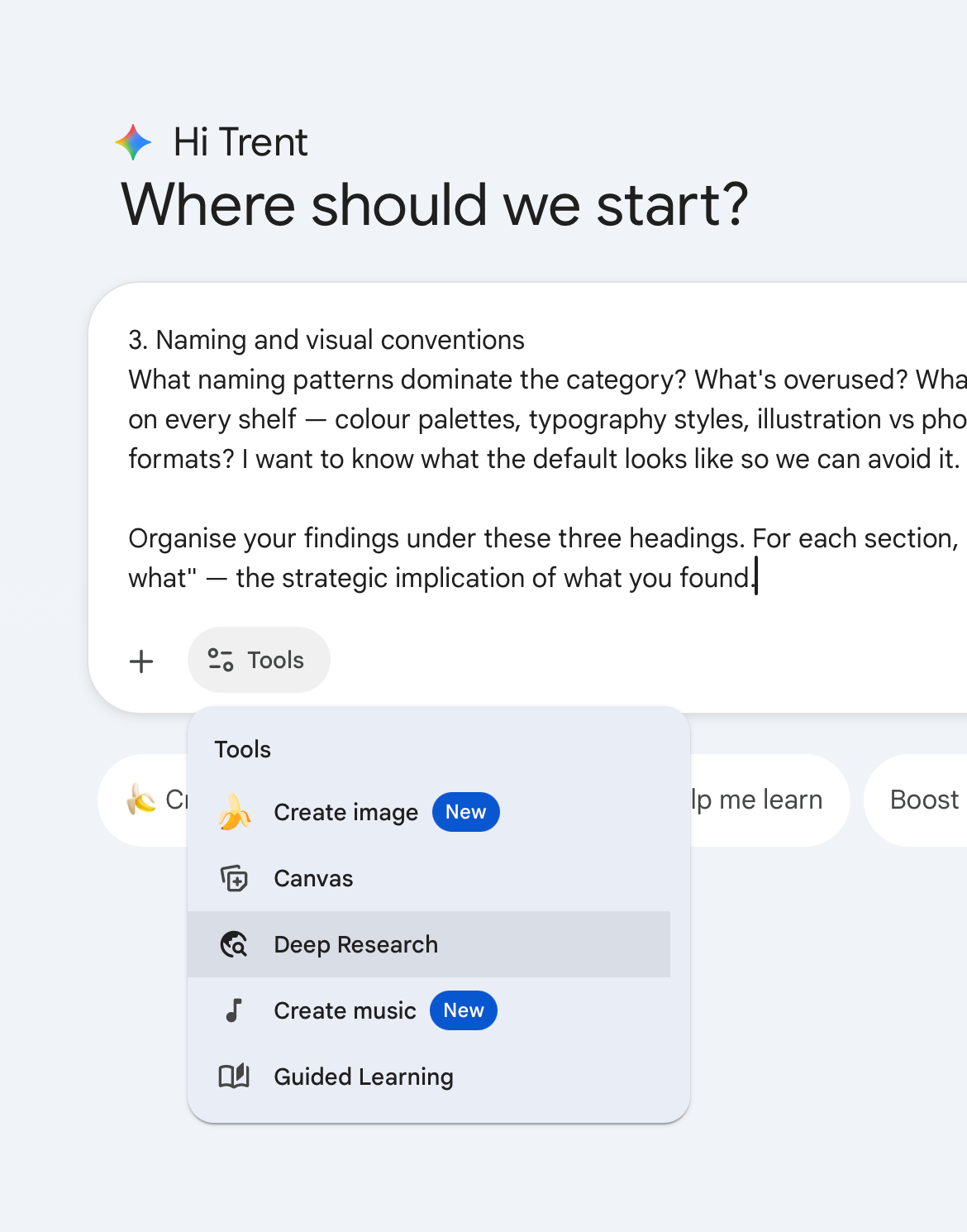
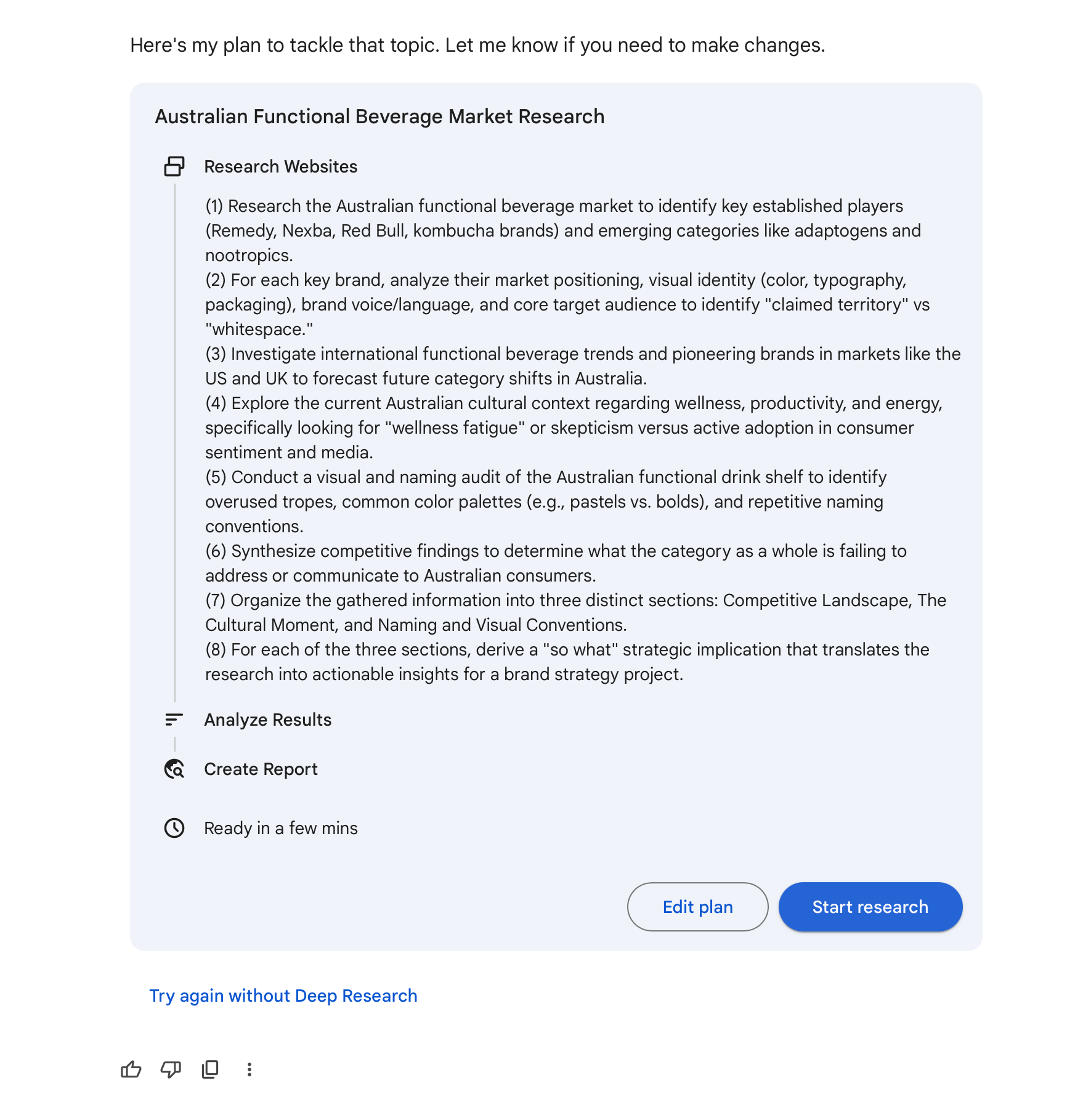
You're about to run a deep research sprint using Gemini Deep Research. Gemini will work autonomously while you eat dinner — investigating the competitive landscape, the cultural moment, and the naming and visual conventions across the category.
The key skill here is writing a research brief, not a search query. The difference between typing "functional drinks Australia" and giving Gemini structured areas of investigation is the difference between getting a list and getting insight.
Paste this prompt into Gemini Deep Research, hit go, and head to dinner. It'll be ready when you get back.
Google Workspace
I need a comprehensive research report on the Australian functional beverage category. This is for a brand strategy project — I'm looking for strategic insight, not just a list of players.
Please investigate three areas:
1. Competitive landscape
Who are the key brands in the Australian functional drink space? For each, I need: their positioning, their visual identity approach, the language they use, and the audience they're targeting. Pay attention to what they all say — and what none of them say. I'm looking for claimed territory and open whitespace.
Include: Remedy, Nexba, Liquid Death (Australian presence), Red Bull, Kombucha brands, any emerging adaptogen or nootropic drinks. Also look at relevant international brands that signal where the category is heading.
2. The cultural moment
What's happening in Australian attitudes toward wellness, productivity, energy, and functional food and drink right now? I need to understand the cultural tension — are people buying into wellness branding or getting tired of it? What's the mood? Look at consumer sentiment, media coverage, social conversation, and any relevant trend data.
3. Naming and visual conventions
What naming patterns dominate the category? What's overused? What visual tropes appear on every shelf — colour palettes, typography styles, illustration vs photography, packaging formats? I want to know what the default looks like so we can avoid it.
Organise your findings under these three headings. For each section, end with a short "so what" — the strategic implication of what you found.
At work tomorrow
This same research brief structure works on any category, client, or pitch. Swap the product, keep the structure. What used to take a research team a week takes Gemini twenty minutes.
20-minute break
Dinner
Gemini is researching while you eat.
Post-dinner — ~50 minutes
Step 04
Extract insights from your researchPrompt chaining
Your Gemini research is done. Now take the entire output and feed it into Claude. This is prompt chaining — one tool's output becomes the next tool's input. Each step builds on the last.
You're not asking Claude to summarise. You're asking it to extract options — three audience mindsets, three brand enemies, and one cultural tension. These become the choices you make in the next step.
H+Co ChatGPT
You are a senior brand strategist at an independent Australian advertising agency. You specialise in finding whitespace in crowded categories. You have zero patience for obvious thinking.
I ran a deep research sprint on the Australian functional drink category. Below is the full research output. I need you to extract strategic insights from this research — not summarise it.
Here's what I need:
1. Claimed territory
What does every competitor in this category say? What are the recurring themes, messages, and positions? Identify the patterns — the things that are so common they've become wallpaper.
2. Whitespace
What does nobody say? What territories are unclaimed? What audience needs or cultural tensions are being ignored? Be specific — I want gaps I can build a brand in, not vague observations.
3. Three audience mindsets
Based on the research, identify three genuinely distinct types of people who might buy a functional drink — not demographics, but mindsets. How do they think about energy, wellness, and productivity? What do they currently do instead? What would make them switch? Give each mindset a short name and 2-3 sentences of description. Make them meaningfully different from each other.
4. Three brand enemies
Propose three beliefs, behaviours, or cultural norms that a new functional drink brand could fight against. Not competitors — ways of thinking. Each enemy should be something real that exists in the culture, not a strawman. Give each a short name and 2-3 sentences explaining what it is and why it's worth fighting.
5. One cultural tension
What single unresolved tension in the category gives a new brand permission to exist? Frame it as a contradiction people tolerate but shouldn't have to.
Be sharp and opinionated. I'd rather you be wrong and interesting than right and boring.
---
[PASTE YOUR GEMINI DEEP RESEARCH OUTPUT HERE]
Read the output carefully. You should have a clear picture of what the category looks like, where the gaps are, and three distinct options for both audience and enemy. These are your starting point for the decisions ahead.
At work tomorrow
This research-to-extraction workflow transfers directly to any brief, pitch, or category review. Run Gemini on a client's competitive landscape, paste it into Claude, extract the strategic insights. What used to take a week takes an evening.
Step 05
Make your choicesRole prompting
This is where your brand becomes yours. You're going to make four decisions, and every one of them makes your brand different from everyone else's in the room.
At each stage, you'll ask Claude to expand on your choice. Each prompt assigns Claude a different role — a strategist, a cultural critic, a brand consultant. That's role prompting: same question, different expertise, different angle. Expect Claude to push back — offering alternatives, asking why — before you lock in each choice. That friction is where real divergence happens.
1 Pick your audience
Look at the three audience mindsets from your extraction. Pick the one that resonates most. This is the person your brand is for — not a demographic, a worldview.
Then use this prompt to expand on your choice. Notice the role: a senior brand strategist produces different depth than an unassigned Claude.
H+Co ChatGPT
You are a senior brand strategist who has spent 15 years building challenger brands in competitive Australian FMCG categories. You understand how to turn an audience insight into a brand that actually connects.
I'm building a new Australian functional drink brand. From my research, I've chosen this audience mindset:
[PASTE YOUR CHOSEN AUDIENCE MINDSET HERE]
Expand on this audience. I need to understand:
- Who is this person really? Not demographics — describe their worldview, their daily reality, how they think about what they consume.
- What do they believe that most people in the category ignore?
- What are they currently doing instead of buying a functional drink? What's the substitute behaviour?
- What would make them switch? What would a brand need to say or do or feel like to get their attention?
Before confirming, push back. Offer one alternative I might not have considered. Ask me why this audience over the others.
Be specific and grounded. No aspirational nonsense — I want to recognise a real person in your description.
2 Pick your enemy
Look at the three brand enemies from your extraction. Pick the one your brand will fight. Not a competitor — a belief or behaviour.
This time Claude is assigned the role of a cultural critic. Different role, different output.
H+Co ChatGPT
You are a cultural critic who writes about brands, consumerism, and the stories companies tell. You're sharp, slightly cynical, and always looking for who benefits from the status quo.
I'm building a new Australian functional drink brand. I've chosen this as my brand enemy — the belief or behaviour my brand is fighting against:
[PASTE YOUR CHOSEN BRAND ENEMY HERE]
Sharpen this enemy for me:
- Why does this belief or behaviour exist? What sustains it?
- Who benefits from it staying the way it is?
- What would it actually look like to challenge it — not in advertising, but in how a brand behaves?
- What's the risk of fighting this enemy? Where could it go wrong?
Before confirming, push back. Suggest one reason this enemy might be wrong. Ask me to defend my choice.
Don't soften it. I need to understand what I'm up against.
3 Pick your tone
This is a human-only decision. No prompt needed. Pick one of three. No middle ground.
Irreverent
Confident, slightly cheeky, willing to poke fun at the category. Doesn't take itself too seriously.
"Your kombucha is trying too hard. We're just a drink."
Understated
Quiet confidence. Says less, means more. Premium without performing it.
"Feel good. Get on with your day."
Earnest
Genuine, warm, direct. Believes in what it's doing without being preachy about it.
"We made this because we wanted something better. We think you will too."
Pick one. Write it down. This filters everything that follows — naming, visual identity, copy, video, everything.
4 Pick your word
If your brand could own one word in the customer's mind, what would it be? Ask Claude to propose five based on the decisions you've already made.
H+Co ChatGPT
I'm building a new Australian functional drink brand. Here are the strategic decisions I've made so far:
Audience: [PASTE YOUR CHOSEN AUDIENCE]
Enemy: [PASTE YOUR CHOSEN ENEMY]
Tone: [YOUR CHOICE: irreverent, understated, or earnest]
Based on these decisions, propose five single words this brand could own in the customer's mind. Not taglines. Not phrases. Single words.
For each word:
- State the word
- Write one sentence defending why it's the right word for this specific audience, against this specific enemy, in this specific tone
After I pick a word, push back. Tell me what's risky about it. Suggest one word I didn't ask for.
The words should be genuinely different from each other — not five synonyms. I want range so I can make a real choice.
Pick one word. Then write one sentence defending your choice — in your own words, not AI-generated. This is the only thing you write yourself tonight. It forces you to commit.
Compile your Brand Strategy
Four decisions made. Now pull everything together into a single-page document.
H+Co ChatGPT
Compile my brand strategy into a single clean document. Here are the decisions I've made:
Audience: [PASTE YOUR CHOSEN AUDIENCE — the expanded version]
Enemy: [PASTE YOUR CHOSEN ENEMY — the expanded version]
Tone: [YOUR CHOICE: irreverent, understated, or earnest]
One word: [YOUR CHOSEN WORD]
My defence of this word: [YOUR OWN SENTENCE]
Cultural tension from research: [PASTE THE CULTURAL TENSION FROM THE EXTRACTION]
Write this as a one-page Brand Strategy document. Use these exact sections:
1. The Person — who this brand is for (one paragraph)
2. The Enemy — what this brand is against (one paragraph)
3. The Tone — how this brand speaks (one sentence plus a short "sounds like / doesn't sound like" comparison)
4. The Word — the one word this brand owns, with the defence
5. The Tension — the cultural tension that gives this brand permission to exist
Keep it tight. No repetition, no padding. This document will be the foundation for naming, visual identity, and every asset I build over the next three weeks.
When you're done
Create a new folder in H+Co ChatGPT for your brand project. Save your Brand Strategy document in this folder. From Session 2 onwards, every conversation about your brand lives here.
Read it through. Revise anything that doesn't feel right. This document is the input for Session 2 — naming, the Brand Bible, and your brand assistant.
At work tomorrow
Role prompting works on any brief or strategy question. Assign Claude the role of a competitor, a sceptical consumer, a media buyer, or a CFO who needs to justify the spend. Different perspectives surface different problems.
Techniques you learned tonight
Technique
What it does
When to use it
Prompt chaining
One tool's output becomes the next tool's input — each step builds on the last
Research sprints, multi-stage workflows, any task where the output of one step informs the next
Role prompting
Assigning Claude a specific perspective or expertise before you ask your question
Interrogating briefs, getting expert-angle feedback, pressure-testing ideas from different perspectives
Pre-dinner — ~30 minutes
Step 01
Read your brief
Everyone is building the same product. The category is booming but predictable — split between vet-endorsed clinical brands that make you feel guilty for not spending more, and supermarket staples hiding behind stock photos of happy dogs. Your job across four weeks is to find the territory in between.
Your brief
A premium, Australian-made dry dog food. Natural ingredients. Three recipes at launch.
Category: Premium pet food — one of the fastest-growing segments in Australian retail. Currently dominated by two extremes: clinical vet-endorsed brands that guilt you into spending more, and supermarket brands that hide behind happy dog photos.
Competition: Royal Canin (vet-endorsed, clinical, premium), Black Hawk (Australian, natural, mid-premium), Advance (science-led, functional), Ivory Coat (grain-free, holistic). None of them talk to the person who loves their dog but doesn't want to be talked to like a helicopter parent.
The person: Loves their dog. Feeds them well. But doesn't define their identity around being a "pet parent." Not into grain-free anxiety or raw-food evangelism. Just wants good food, clearly made, no guilt trips.
The occasion: Standing in the pet food aisle on a Saturday, overwhelmed by claims. Or: reordering online and wondering if they should switch from the brand that's been steadily getting more expensive.
The tension: Every premium dog food either talks to you like you're neglecting your dog (vet brands) or like you're buying a lifestyle (boutique brands). Nobody just makes good food and lets you get on with it.
Read it carefully. The brief gives you the tension — your job is to resolve it. Every decision you make tonight and over the next three weeks flows from this starting point.
Tonight's techniques at a glance:
Technique
What it does
Prompt chaining
One tool's output becomes the next tool's input — each step builds on the last
Role prompting
Assigning Claude a specific perspective or expertise before you ask your question
Step 02
Write your Personal Brief
Before you touch the brand, tell AI who you are. This is the single biggest unlock most people miss. AI gives generic output because it doesn't know anything about you — your role, your expertise, how you think, what good work looks like in your world.
Instead of filling in a template, you're going to ask Claude to interview you. Claude asks the questions, one at a time. You answer in your own words. When it has enough, it writes your Personal Brief.
This works better than a form because people don't always know what's relevant about themselves. Claude asks the right questions and follows up where it's useful.
H+Co ChatGPT
I need you to interview me so you can write my Personal Brief — a short document about who I am and how I work that I'll paste into AI conversations to get better, more relevant output.
Here's how this works:
- Ask me one question at a time.
- Keep it conversational — no forms, no bullet-point lists of things to fill in.
- Probe deeper where it's useful. If I say something vague, ask a follow-up.
- Stop when you have enough to write the brief.
You need to cover:
- My role and what I actually do day-to-day
- Any specialist knowledge or expertise I bring
- How I communicate — formal or casual, direct or detailed
- What I value in good work
- What frustrates me or wastes my time
- What kinds of tasks I'd use AI for
When you're done interviewing me, write my Personal Brief as a concise third-person document (e.g. "[Name] is a…") under 200 words. No filler, no flattery. Every sentence should be useful. The goal is to give AI enough context about me that its output is immediately more relevant.
Start by asking me your first question.
Claude will ask you questions one at a time. Just answer honestly — short answers are fine. When it produces your brief, read it and push back. "That's too formal." "You missed that I specialise in X." "Make the communication style bit more specific." Two or three rounds of revision is normal.
When you're done
Paste your finished Personal Brief into H+Co ChatGPT → Settings → System Prompt. From now on, every conversation you have starts with Claude knowing who you are — in the workshop and at work.
At work tomorrow
Your Personal Brief works on any project. Paste it in before writing a brief, drafting a presentation, summarising a meeting, or doing research. The difference is immediate.
Step 03
Launch your research
You're about to run a deep research sprint using Gemini Deep Research. Gemini will work autonomously while you eat dinner — investigating the competitive landscape, the cultural moment, and the naming and visual conventions across the category.
The key skill here is writing a research brief, not a search query. The difference between typing "premium dog food Australia" and giving Gemini structured areas of investigation is the difference between getting a list and getting insight.
Paste this prompt into Gemini Deep Research, hit go, and head to dinner. It'll be ready when you get back.
Google Workspace
I need a comprehensive research report on the Australian premium pet food category, with a specific focus on premium dry dog food. This is for a brand strategy project — I'm looking for strategic insight, not just a list of players.
Please investigate three areas:
1. Competitive landscape
Who are the key brands in the Australian premium dog food space? For each, I need: their positioning, their visual identity approach, the language they use, and the audience they're targeting. Pay attention to what they all say — and what none of them say. I'm looking for claimed territory and open whitespace.
Include: Royal Canin, Black Hawk, Advance, Ivory Coat, Open Farm, Scratch, Lyka (fresh food competitor), any emerging Australian-made or DTC dog food brands. Also look at relevant international brands that signal where the category is heading.
2. The cultural moment
What's happening in Australian attitudes toward pet ownership, pet food, humanisation of pets, and premium pet spending right now? I need to understand the cultural tension — are people buying into the "pet parent" identity or getting tired of it? What's the mood? Look at consumer sentiment, media coverage, social conversation, and any relevant trend data.
3. Naming and visual conventions
What naming patterns dominate the category? What's overused? What visual tropes appear on every shelf — colour palettes, typography styles, illustration vs photography, packaging formats? I want to know what the default looks like so we can avoid it.
Organise your findings under these three headings. For each section, end with a short "so what" — the strategic implication of what you found.
At work tomorrow
This same research brief structure works on any category, client, or pitch. Swap the product, keep the structure. What used to take a research team a week takes Gemini twenty minutes.
20-minute break
Dinner
Gemini is researching while you eat.
Post-dinner — ~50 minutes
Step 04
Extract insights from your researchPrompt chaining
Your Gemini research is done. Now take the entire output and feed it into Claude. This is prompt chaining — one tool's output becomes the next tool's input. Each step builds on the last.
You're not asking Claude to summarise. You're asking it to extract options — three audience mindsets, three brand enemies, and one cultural tension. These become the choices you make in the next step.
H+Co ChatGPT
You are a senior brand strategist at an independent Australian advertising agency. You specialise in finding whitespace in crowded categories. You have zero patience for obvious thinking.
I ran a deep research sprint on the Australian premium pet food category. Below is the full research output. I need you to extract strategic insights from this research — not summarise it.
Here's what I need:
1. Claimed territory
What does every competitor in this category say? What are the recurring themes, messages, and positions? Identify the patterns — the things that are so common they've become wallpaper.
2. Whitespace
What does nobody say? What territories are unclaimed? What audience needs or cultural tensions are being ignored? Be specific — I want gaps I can build a brand in, not vague observations.
3. Three audience mindsets
Based on the research, identify three genuinely distinct types of people who might buy a premium dog food — not demographics, but mindsets. How do they think about feeding their dog, about pet ownership, about spending? What do they currently do instead? What would make them switch? Give each mindset a short name and 2-3 sentences of description. Make them meaningfully different from each other.
4. Three brand enemies
Propose three beliefs, behaviours, or cultural norms that a new premium dog food brand could fight against. Not competitors — ways of thinking. Each enemy should be something real that exists in the culture, not a strawman. Give each a short name and 2-3 sentences explaining what it is and why it's worth fighting.
5. One cultural tension
What single unresolved tension in the category gives a new brand permission to exist? Frame it as a contradiction people tolerate but shouldn't have to.
Be sharp and opinionated. I'd rather you be wrong and interesting than right and boring.
---
[PASTE YOUR GEMINI DEEP RESEARCH OUTPUT HERE]
Read the output carefully. You should have a clear picture of what the category looks like, where the gaps are, and three distinct options for both audience and enemy. These are your starting point for the decisions ahead.
At work tomorrow
This research-to-extraction workflow transfers directly to any brief, pitch, or category review. Run Gemini on a client's competitive landscape, paste it into Claude, extract the strategic insights. What used to take a week takes an evening.
Step 05
Make your choicesRole prompting
This is where your brand becomes yours. You're going to make four decisions, and every one of them makes your brand different from everyone else's in the room.
At each stage, you'll ask Claude to expand on your choice. Each prompt assigns Claude a different role — a strategist, a cultural critic, a brand consultant. That's role prompting: same question, different expertise, different angle. Expect Claude to push back — offering alternatives, asking why — before you lock in each choice. That friction is where real divergence happens.
1 Pick your audience
Look at the three audience mindsets from your extraction. Pick the one that resonates most. This is the person your brand is for — not a demographic, a worldview.
Then use this prompt to expand on your choice. Notice the role: a senior brand strategist produces different depth than an unassigned Claude.
H+Co ChatGPT
You are a senior brand strategist who has spent 15 years building challenger brands in competitive Australian FMCG categories. You understand how to turn an audience insight into a brand that actually connects.
I'm building a new Australian premium dog food brand. From my research, I've chosen this audience mindset:
[PASTE YOUR CHOSEN AUDIENCE MINDSET HERE]
Expand on this audience. I need to understand:
- Who is this person really? Not demographics — describe their worldview, their daily reality, how they think about what they consume.
- What do they believe that most people in the category ignore?
- What are they currently doing instead of buying a premium dog food? What's the substitute behaviour?
- What would make them switch? What would a brand need to say or do or feel like to get their attention?
Before confirming, push back. Offer one alternative I might not have considered. Ask me why this audience over the others.
Be specific and grounded. No aspirational nonsense — I want to recognise a real person in your description.
2 Pick your enemy
Look at the three brand enemies from your extraction. Pick the one your brand will fight. Not a competitor — a belief or behaviour.
This time Claude is assigned the role of a cultural critic. Different role, different output.
H+Co ChatGPT
You are a cultural critic who writes about brands, consumerism, and the stories companies tell. You're sharp, slightly cynical, and always looking for who benefits from the status quo.
I'm building a new Australian premium dog food brand. I've chosen this as my brand enemy — the belief or behaviour my brand is fighting against:
[PASTE YOUR CHOSEN BRAND ENEMY HERE]
Sharpen this enemy for me:
- Why does this belief or behaviour exist? What sustains it?
- Who benefits from it staying the way it is?
- What would it actually look like to challenge it — not in advertising, but in how a brand behaves?
- What's the risk of fighting this enemy? Where could it go wrong?
Before confirming, push back. Suggest one reason this enemy might be wrong. Ask me to defend my choice.
Don't soften it. I need to understand what I'm up against.
3 Pick your tone
This is a human-only decision. No prompt needed. Pick one of three. No middle ground.
Irreverent
Confident, slightly cheeky, willing to poke fun at the category. Doesn't take itself too seriously.
"Your vet's premium pick costs $90 a bag. We just made good food."
Understated
Quiet confidence. Says less, means more. Premium without performing it.
"Good food. Happy dog. That's it."
Earnest
Genuine, warm, direct. Believes in what it's doing without being preachy about it.
"We made this because we wanted something better for our dogs. We think you will too."
Pick one. Write it down. This filters everything that follows — naming, visual identity, copy, video, everything.
4 Pick your word
If your brand could own one word in the customer's mind, what would it be? Ask Claude to propose five based on the decisions you've already made.
H+Co ChatGPT
I'm building a new Australian premium dog food brand. Here are the strategic decisions I've made so far:
Audience: [PASTE YOUR CHOSEN AUDIENCE]
Enemy: [PASTE YOUR CHOSEN ENEMY]
Tone: [YOUR CHOICE: irreverent, understated, or earnest]
Based on these decisions, propose five single words this brand could own in the customer's mind. Not taglines. Not phrases. Single words.
For each word:
- State the word
- Write one sentence defending why it's the right word for this specific audience, against this specific enemy, in this specific tone
After I pick a word, push back. Tell me what's risky about it. Suggest one word I didn't ask for.
The words should be genuinely different from each other — not five synonyms. I want range so I can make a real choice.
Pick one word. Then write one sentence defending your choice — in your own words, not AI-generated. This is the only thing you write yourself tonight. It forces you to commit.
Compile your Brand Strategy
Four decisions made. Now pull everything together into a single-page document.
H+Co ChatGPT
Compile my brand strategy into a single clean document. Here are the decisions I've made:
Audience: [PASTE YOUR CHOSEN AUDIENCE — the expanded version]
Enemy: [PASTE YOUR CHOSEN ENEMY — the expanded version]
Tone: [YOUR CHOICE: irreverent, understated, or earnest]
One word: [YOUR CHOSEN WORD]
My defence of this word: [YOUR OWN SENTENCE]
Cultural tension from research: [PASTE THE CULTURAL TENSION FROM THE EXTRACTION]
Write this as a one-page Brand Strategy document. Use these exact sections:
1. The Person — who this brand is for (one paragraph)
2. The Enemy — what this brand is against (one paragraph)
3. The Tone — how this brand speaks (one sentence plus a short "sounds like / doesn't sound like" comparison)
4. The Word — the one word this brand owns, with the defence
5. The Tension — the cultural tension that gives this brand permission to exist
Keep it tight. No repetition, no padding. This document will be the foundation for naming, visual identity, and every asset I build over the next three weeks.
When you're done
Create a new folder in H+Co ChatGPT for your brand project. Save your Brand Strategy document in this folder. From Session 2 onwards, every conversation about your brand lives here.
Read it through. Revise anything that doesn't feel right. This document is the input for Session 2 — naming, the Brand Bible, and your brand assistant.
At work tomorrow
Role prompting works on any brief or strategy question. Assign Claude the role of a competitor, a sceptical consumer, a media buyer, or a CFO who needs to justify the spend. Different perspectives surface different problems.
Techniques you learned tonight
Technique
What it does
When to use it
Prompt chaining
One tool's output becomes the next tool's input — each step builds on the last
Research sprints, multi-stage workflows, any task where the output of one step informs the next
Role prompting
Assigning Claude a specific perspective or expertise before you ask your question
Interrogating briefs, getting expert-angle feedback, pressure-testing ideas from different perspectives
Pre-dinner — ~30 minutes
Step 01
Read your brief
Everyone is building the same product. The category is one of the most trusted and most boring in Australian retail — pharmacy brands that feel like medical compliance, and beauty brands that treat SPF as a skincare flex. Your job across four weeks is to find the territory in between.
Your brief
A daily-wear SPF50+ sunscreen. Australian-made. Lightweight formula. Three variants at launch (face, body, tinted).
Category: Suncare — one of the most trusted and most boring categories in Australian retail. Currently dominated by two extremes: pharmacy brands that feel like medical compliance, and beauty brands that treat sunscreen as skincare with SPF tacked on.
Competition: Cancer Council (trusted, institutional, duty-driven), Bondi Sands (lifestyle, beach, aspirational), Ultra Violette (beauty-first, premium, Gen Z), Banana Boat (family, fun, mass market). None of them talk to the person who wears sunscreen every day but doesn't want it to feel like either a chore or a beauty ritual.
The person: Wears sunscreen because they know they should. Doesn't need convincing about UV damage. But doesn't want sunscreen to be a whole thing — not a 12-step skincare routine, not a beach lifestyle, not a guilt trip from a cancer charity.
The occasion: 7:30am on a weekday. Getting ready for work. Sunscreen is the last step before keys and phone. Or: Saturday morning before taking the kids to sport. It should be as automatic as deodorant.
The tension: Every sunscreen brand either makes you feel guilty (health brands) or makes you feel like you need to be beautiful (beauty brands). Nobody just makes sunscreen for people who wear it every day because it's the smart thing to do.
Read it carefully. The brief gives you the tension — your job is to resolve it. Every decision you make tonight and over the next three weeks flows from this starting point.
Tonight's techniques at a glance:
Technique
What it does
Prompt chaining
One tool's output becomes the next tool's input — each step builds on the last
Role prompting
Assigning Claude a specific perspective or expertise before you ask your question
Step 02
Write your Personal Brief
Before you touch the brand, tell AI who you are. This is the single biggest unlock most people miss. AI gives generic output because it doesn't know anything about you — your role, your expertise, how you think, what good work looks like in your world.
Instead of filling in a template, you're going to ask Claude to interview you. Claude asks the questions, one at a time. You answer in your own words. When it has enough, it writes your Personal Brief.
This works better than a form because people don't always know what's relevant about themselves. Claude asks the right questions and follows up where it's useful.
H+Co ChatGPT
I need you to interview me so you can write my Personal Brief — a short document about who I am and how I work that I'll paste into AI conversations to get better, more relevant output.
Here's how this works:
- Ask me one question at a time.
- Keep it conversational — no forms, no bullet-point lists of things to fill in.
- Probe deeper where it's useful. If I say something vague, ask a follow-up.
- Stop when you have enough to write the brief.
You need to cover:
- My role and what I actually do day-to-day
- Any specialist knowledge or expertise I bring
- How I communicate — formal or casual, direct or detailed
- What I value in good work
- What frustrates me or wastes my time
- What kinds of tasks I'd use AI for
When you're done interviewing me, write my Personal Brief as a concise third-person document (e.g. "[Name] is a…") under 200 words. No filler, no flattery. Every sentence should be useful. The goal is to give AI enough context about me that its output is immediately more relevant.
Start by asking me your first question.
Claude will ask you questions one at a time. Just answer honestly — short answers are fine. When it produces your brief, read it and push back. "That's too formal." "You missed that I specialise in X." "Make the communication style bit more specific." Two or three rounds of revision is normal.
When you're done
Paste your finished Personal Brief into H+Co ChatGPT → Settings → System Prompt. From now on, every conversation you have starts with Claude knowing who you are — in the workshop and at work.
At work tomorrow
Your Personal Brief works on any project. Paste it in before writing a brief, drafting a presentation, summarising a meeting, or doing research. The difference is immediate.
Step 03
Launch your research
You're about to run a deep research sprint using Gemini Deep Research. Gemini will work autonomously while you eat dinner — investigating the competitive landscape, the cultural moment, and the naming and visual conventions across the category.
The key skill here is writing a research brief, not a search query. The difference between typing "sunscreen Australia" and giving Gemini structured areas of investigation is the difference between getting a list and getting insight.
Paste this prompt into Gemini Deep Research, hit go, and head to dinner. It'll be ready when you get back.
Google Workspace
I need a comprehensive research report on the Australian suncare and sunscreen category. This is for a brand strategy project — I'm looking for strategic insight, not just a list of players.
Please investigate three areas:
1. Competitive landscape
Who are the key brands in the Australian sunscreen space? For each, I need: their positioning, their visual identity approach, the language they use, and the audience they're targeting. Pay attention to what they all say — and what none of them say. I'm looking for claimed territory and open whitespace.
Include: Cancer Council, Bondi Sands, Ultra Violette, Banana Boat, La Roche-Posay (Australian presence), Hamilton, Invisible Zinc, and any emerging daily-wear SPF brands. Also look at relevant international brands that signal where the category is heading.
2. The cultural moment
What's happening in Australian attitudes toward sun protection, daily SPF use, skin health, and the intersection of suncare and skincare right now? I need to understand the cultural tension — are people buying into the beauty-fication of sunscreen or getting tired of it? What's the mood? Look at consumer sentiment, media coverage, social conversation, and any relevant trend data.
3. Naming and visual conventions
What naming patterns dominate the category? What's overused? What visual tropes appear on every shelf — colour palettes, typography styles, illustration vs photography, packaging formats? I want to know what the default looks like so we can avoid it.
Organise your findings under these three headings. For each section, end with a short "so what" — the strategic implication of what you found.
At work tomorrow
This same research brief structure works on any category, client, or pitch. Swap the product, keep the structure. What used to take a research team a week takes Gemini twenty minutes.
20-minute break
Dinner
Gemini is researching while you eat.
Post-dinner — ~50 minutes
Step 04
Extract insights from your researchPrompt chaining
Your Gemini research is done. Now take the entire output and feed it into Claude. This is prompt chaining — one tool's output becomes the next tool's input. Each step builds on the last.
You're not asking Claude to summarise. You're asking it to extract options — three audience mindsets, three brand enemies, and one cultural tension. These become the choices you make in the next step.
H+Co ChatGPT
You are a senior brand strategist at an independent Australian advertising agency. You specialise in finding whitespace in crowded categories. You have zero patience for obvious thinking.
I ran a deep research sprint on the Australian suncare category. Below is the full research output. I need you to extract strategic insights from this research — not summarise it.
Here's what I need:
1. Claimed territory
What does every competitor in this category say? What are the recurring themes, messages, and positions? Identify the patterns — the things that are so common they've become wallpaper.
2. Whitespace
What does nobody say? What territories are unclaimed? What audience needs or cultural tensions are being ignored? Be specific — I want gaps I can build a brand in, not vague observations.
3. Three audience mindsets
Based on the research, identify three genuinely distinct types of people who might buy a sunscreen — not demographics, but mindsets. How do they think about sun protection, skincare, and daily habits? What do they currently do instead? What would make them switch? Give each mindset a short name and 2-3 sentences of description. Make them meaningfully different from each other.
4. Three brand enemies
Propose three beliefs, behaviours, or cultural norms that a new sunscreen brand could fight against. Not competitors — ways of thinking. Each enemy should be something real that exists in the culture, not a strawman. Give each a short name and 2-3 sentences explaining what it is and why it's worth fighting.
5. One cultural tension
What single unresolved tension in the category gives a new brand permission to exist? Frame it as a contradiction people tolerate but shouldn't have to.
Be sharp and opinionated. I'd rather you be wrong and interesting than right and boring.
---
[PASTE YOUR GEMINI DEEP RESEARCH OUTPUT HERE]
Read the output carefully. You should have a clear picture of what the category looks like, where the gaps are, and three distinct options for both audience and enemy. These are your starting point for the decisions ahead.
At work tomorrow
This research-to-extraction workflow transfers directly to any brief, pitch, or category review. Run Gemini on a client's competitive landscape, paste it into Claude, extract the strategic insights. What used to take a week takes an evening.
Step 05
Make your choicesRole prompting
This is where your brand becomes yours. You're going to make four decisions, and every one of them makes your brand different from everyone else's in the room.
At each stage, you'll ask Claude to expand on your choice. Each prompt assigns Claude a different role — a strategist, a cultural critic, a brand consultant. That's role prompting: same question, different expertise, different angle. Expect Claude to push back — offering alternatives, asking why — before you lock in each choice. That friction is where real divergence happens.
1 Pick your audience
Look at the three audience mindsets from your extraction. Pick the one that resonates most. This is the person your brand is for — not a demographic, a worldview.
Then use this prompt to expand on your choice. Notice the role: a senior brand strategist produces different depth than an unassigned Claude.
H+Co ChatGPT
You are a senior brand strategist who has spent 15 years building challenger brands in competitive Australian FMCG categories. You understand how to turn an audience insight into a brand that actually connects.
I'm building a new Australian daily sunscreen brand. From my research, I've chosen this audience mindset:
[PASTE YOUR CHOSEN AUDIENCE MINDSET HERE]
Expand on this audience. I need to understand:
- Who is this person really? Not demographics — describe their worldview, their daily reality, how they think about what they consume.
- What do they believe that most people in the category ignore?
- What are they currently doing instead of buying a daily sunscreen? What's the substitute behaviour?
- What would make them switch? What would a brand need to say or do or feel like to get their attention?
Before confirming, push back. Offer one alternative I might not have considered. Ask me why this audience over the others.
Be specific and grounded. No aspirational nonsense — I want to recognise a real person in your description.
2 Pick your enemy
Look at the three brand enemies from your extraction. Pick the one your brand will fight. Not a competitor — a belief or behaviour.
This time Claude is assigned the role of a cultural critic. Different role, different output.
H+Co ChatGPT
You are a cultural critic who writes about brands, consumerism, and the stories companies tell. You're sharp, slightly cynical, and always looking for who benefits from the status quo.
I'm building a new Australian daily sunscreen brand. I've chosen this as my brand enemy — the belief or behaviour my brand is fighting against:
[PASTE YOUR CHOSEN BRAND ENEMY HERE]
Sharpen this enemy for me:
- Why does this belief or behaviour exist? What sustains it?
- Who benefits from it staying the way it is?
- What would it actually look like to challenge it — not in advertising, but in how a brand behaves?
- What's the risk of fighting this enemy? Where could it go wrong?
Before confirming, push back. Suggest one reason this enemy might be wrong. Ask me to defend my choice.
Don't soften it. I need to understand what I'm up against.
3 Pick your tone
This is a human-only decision. No prompt needed. Pick one of three. No middle ground.
Irreverent
Confident, slightly cheeky, willing to poke fun at the category. Doesn't take itself too seriously.
"Your skincare routine has eleven steps. Ours has one."
Understated
Quiet confidence. Says less, means more. Premium without performing it.
"SPF50+. Every day. Done."
Earnest
Genuine, warm, direct. Believes in what it's doing without being preachy about it.
"We made this because sunscreen shouldn't feel like a sacrifice. We think you'll agree."
Pick one. Write it down. This filters everything that follows — naming, visual identity, copy, video, everything.
4 Pick your word
If your brand could own one word in the customer's mind, what would it be? Ask Claude to propose five based on the decisions you've already made.
H+Co ChatGPT
I'm building a new Australian daily sunscreen brand. Here are the strategic decisions I've made so far:
Audience: [PASTE YOUR CHOSEN AUDIENCE]
Enemy: [PASTE YOUR CHOSEN ENEMY]
Tone: [YOUR CHOICE: irreverent, understated, or earnest]
Based on these decisions, propose five single words this brand could own in the customer's mind. Not taglines. Not phrases. Single words.
For each word:
- State the word
- Write one sentence defending why it's the right word for this specific audience, against this specific enemy, in this specific tone
After I pick a word, push back. Tell me what's risky about it. Suggest one word I didn't ask for.
The words should be genuinely different from each other — not five synonyms. I want range so I can make a real choice.
Pick one word. Then write one sentence defending your choice — in your own words, not AI-generated. This is the only thing you write yourself tonight. It forces you to commit.
Compile your Brand Strategy
Four decisions made. Now pull everything together into a single-page document.
H+Co ChatGPT
Compile my brand strategy into a single clean document. Here are the decisions I've made:
Audience: [PASTE YOUR CHOSEN AUDIENCE — the expanded version]
Enemy: [PASTE YOUR CHOSEN ENEMY — the expanded version]
Tone: [YOUR CHOICE: irreverent, understated, or earnest]
One word: [YOUR CHOSEN WORD]
My defence of this word: [YOUR OWN SENTENCE]
Cultural tension from research: [PASTE THE CULTURAL TENSION FROM THE EXTRACTION]
Write this as a one-page Brand Strategy document. Use these exact sections:
1. The Person — who this brand is for (one paragraph)
2. The Enemy — what this brand is against (one paragraph)
3. The Tone — how this brand speaks (one sentence plus a short "sounds like / doesn't sound like" comparison)
4. The Word — the one word this brand owns, with the defence
5. The Tension — the cultural tension that gives this brand permission to exist
Keep it tight. No repetition, no padding. This document will be the foundation for naming, visual identity, and every asset I build over the next three weeks.
When you're done
Create a new folder in H+Co ChatGPT for your brand project. Save your Brand Strategy document in this folder. From Session 2 onwards, every conversation about your brand lives here.
Read it through. Revise anything that doesn't feel right. This document is the input for Session 2 — naming, the Brand Bible, and your brand assistant.
At work tomorrow
Role prompting works on any brief or strategy question. Assign Claude the role of a competitor, a sceptical consumer, a media buyer, or a CFO who needs to justify the spend. Different perspectives surface different problems.
Techniques you learned tonight
Technique
What it does
When to use it
Prompt chaining
One tool's output becomes the next tool's input — each step builds on the last
Research sprints, multi-stage workflows, any task where the output of one step informs the next
Role prompting
Assigning Claude a specific perspective or expertise before you ask your question
Interrogating briefs, getting expert-angle feedback, pressure-testing ideas from different perspectives
Pre-dinner — ~30 minutes
Step 01
Read your brief
Everyone is building the same product. The category is dominated by global performance brands that spend more on marketing than manufacturing — while a growing underground of trail runners want something local, considered, and built for Australian terrain. Your job across four weeks is to find the territory in between.
Your brief
A single Australian-made trail shoe. New brand. One silhouette at launch.
Category: Trail running footwear — a fast-growing segment where global performance brands dominate distribution and mindshare. Currently split between mass-market trail shoes from major athletic brands and a handful of specialist brands with cult followings. The whitespace is a brand that's local, considered, and community-rooted before it's commercial.
Competition: Salomon (ubiquitous, performance-first, gorpcore crossover), HOKA (maximalist, comfort, mainstream trail), Nike Trail (brand leverage, style-led), Merrell (outdoor heritage, practical). None of them are Australian-made, and none of them talk to the person who's tired of seeing the same shoes on every trail.
The person: Runs trails seriously but doesn't need a brand to tell them they're serious. Cares about what's on their feet, notices what other people are wearing, and would rather discover a brand than be sold one. Values craft and locality over global scale.
The occasion: Saturday morning, 6am. A trail they know well enough to run alone. Or: the gear forum post where someone asks "what are you actually running in?" and the answer isn't Salomon.
The tension: Every trail shoe brand either chases mass-market scale (Salomon, HOKA, Nike) or stays so niche it's hard to find. Nobody is building an Australian trail shoe that's genuinely good, genuinely local, and available to the people who care — without trying to be the next global brand.
Read it carefully. The brief gives you the tension — your job is to resolve it. Every decision you make tonight and over the next three weeks flows from this starting point.
Tonight's techniques at a glance:
Technique
What it does
Prompt chaining
One tool's output becomes the next tool's input — each step builds on the last
Role prompting
Assigning Claude a specific perspective or expertise before you ask your question
Step 02
Write your Personal Brief
Before you touch the brand, tell AI who you are. This is the single biggest unlock most people miss. AI gives generic output because it doesn't know anything about you — your role, your expertise, how you think, what good work looks like in your world.
Instead of filling in a template, you're going to ask Claude to interview you. Claude asks the questions, one at a time. You answer in your own words. When it has enough, it writes your Personal Brief.
This works better than a form because people don't always know what's relevant about themselves. Claude asks the right questions and follows up where it's useful.
H+Co ChatGPT
I need you to interview me so you can write my Personal Brief — a short document about who I am and how I work that I'll paste into AI conversations to get better, more relevant output.
Here's how this works:
- Ask me one question at a time.
- Keep it conversational — no forms, no bullet-point lists of things to fill in.
- Probe deeper where it's useful. If I say something vague, ask a follow-up.
- Stop when you have enough to write the brief.
You need to cover:
- My role and what I actually do day-to-day
- Any specialist knowledge or expertise I bring
- How I communicate — formal or casual, direct or detailed
- What I value in good work
- What frustrates me or wastes my time
- What kinds of tasks I'd use AI for
When you're done interviewing me, write my Personal Brief as a concise third-person document (e.g. "[Name] is a…") under 200 words. No filler, no flattery. Every sentence should be useful. The goal is to give AI enough context about me that its output is immediately more relevant.
Start by asking me your first question.
Claude will ask you questions one at a time. Just answer honestly — short answers are fine. When it produces your brief, read it and push back. "That's too formal." "You missed that I specialise in X." "Make the communication style bit more specific." Two or three rounds of revision is normal.
When you're done
Paste your finished Personal Brief into H+Co ChatGPT → Settings → System Prompt. From now on, every conversation you have starts with Claude knowing who you are — in the workshop and at work.
At work tomorrow
Your Personal Brief works on any project. Paste it in before writing a brief, drafting a presentation, summarising a meeting, or doing research. The difference is immediate.
Step 03
Launch your research
You're about to run a deep research sprint using Gemini Deep Research. Gemini will work autonomously while you eat dinner — investigating the competitive landscape, the cultural moment, and the naming and visual conventions across the category.
The key skill here is writing a research brief, not a search query. The difference between typing "trail shoes Australia" and giving Gemini structured areas of investigation is the difference between getting a list and getting insight.
Paste this prompt into Gemini Deep Research, hit go, and head to dinner. It'll be ready when you get back.
Google Workspace
I need a comprehensive research report on the Australian trail running shoe market and the broader gorpcore/outdoor performance footwear movement. This is for a brand strategy project — I'm looking for strategic insight, not just a list of players.
Please investigate three areas:
1. Competitive landscape
Who are the key brands in the trail running shoe space, with particular attention to the Australian market? For each, I need: their positioning, their visual identity approach, the language they use, and the audience they're targeting. Pay attention to what they all say — and what none of them say. I'm looking for claimed territory and open whitespace.
Include: Salomon, HOKA, Nike Trail, Merrell, New Balance Trail, On Running, inov-8, and any emerging Australian-made or independent trail shoe brands. Also look at relevant gorpcore-adjacent brands and small-batch footwear makers that signal where the category is heading.
2. The cultural moment
What's happening in trail running culture, gorpcore, and the intersection of performance gear and fashion right now — particularly in Australia? I need to understand the cultural tension — are people buying into mass-market trail brands or looking for alternatives? What's the mood in trail running communities, gear forums, and outdoor culture? Look at consumer sentiment, media coverage, social conversation, and any relevant trend data.
3. Naming and visual conventions
What naming patterns dominate the trail shoe category? What's overused? What visual tropes appear on every brand — colour palettes, typography styles, photography approaches, packaging formats? I want to know what the default looks like so we can avoid it.
Organise your findings under these three headings. For each section, end with a short "so what" — the strategic implication of what you found.
At work tomorrow
This same research brief structure works on any category, client, or pitch. Swap the product, keep the structure. What used to take a research team a week takes Gemini twenty minutes.
20-minute break
Dinner
Gemini is researching while you eat.
Post-dinner — ~50 minutes
Step 04
Extract insights from your researchPrompt chaining
Your Gemini research is done. Now take the entire output and feed it into Claude. This is prompt chaining — one tool's output becomes the next tool's input. Each step builds on the last.
You're not asking Claude to summarise. You're asking it to extract options — three audience mindsets, three brand enemies, and one cultural tension. These become the choices you make in the next step.
H+Co ChatGPT
You are a senior brand strategist at an independent Australian advertising agency. You specialise in finding whitespace in crowded categories. You have zero patience for obvious thinking.
I ran a deep research sprint on the Australian trail running shoe market and gorpcore movement. Below is the full research output. I need you to extract strategic insights from this research — not summarise it.
Here's what I need:
1. Claimed territory
What does every competitor in this category say? What are the recurring themes, messages, and positions? Identify the patterns — the things that are so common they've become wallpaper.
2. Whitespace
What does nobody say? What territories are unclaimed? What audience needs or cultural tensions are being ignored? Be specific — I want gaps I can build a brand in, not vague observations.
3. Three audience mindsets
Based on the research, identify three genuinely distinct types of people who might buy an Australian-made trail shoe — not demographics, but mindsets. How do they think about gear, about running, about what they put on their feet? What do they currently do instead? What would make them switch? Give each mindset a short name and 2-3 sentences of description. Make them meaningfully different from each other.
4. Three brand enemies
Propose three beliefs, behaviours, or cultural norms that a new Australian trail shoe brand could fight against. Not competitors — ways of thinking. Each enemy should be something real that exists in the culture, not a strawman. Give each a short name and 2-3 sentences explaining what it is and why it's worth fighting.
5. One cultural tension
What single unresolved tension in the category gives a new brand permission to exist? Frame it as a contradiction people tolerate but shouldn't have to.
Be sharp and opinionated. I'd rather you be wrong and interesting than right and boring.
---
[PASTE YOUR GEMINI DEEP RESEARCH OUTPUT HERE]
Read the output carefully. You should have a clear picture of what the category looks like, where the gaps are, and three distinct options for both audience and enemy. These are your starting point for the decisions ahead.
At work tomorrow
This research-to-extraction workflow transfers directly to any brief, pitch, or category review. Run Gemini on a client's competitive landscape, paste it into Claude, extract the strategic insights. What used to take a week takes an evening.
Step 05
Make your choicesRole prompting
This is where your brand becomes yours. You're going to make four decisions, and every one of them makes your brand different from everyone else's in the room.
At each stage, you'll ask Claude to expand on your choice. Each prompt assigns Claude a different role — a strategist, a cultural critic, a brand consultant. That's role prompting: same question, different expertise, different angle. Expect Claude to push back — offering alternatives, asking why — before you lock in each choice. That friction is where real divergence happens.
1 Pick your audience
Look at the three audience mindsets from your extraction. Pick the one that resonates most. This is the person your brand is for — not a demographic, a worldview.
Then use this prompt to expand on your choice. Notice the role: a senior brand strategist produces different depth than an unassigned Claude.
H+Co ChatGPT
You are a senior brand strategist who has spent 15 years building challenger brands in competitive Australian markets. You understand how to turn an audience insight into a brand that actually connects.
I'm building a new Australian trail shoe brand. From my research, I've chosen this audience mindset:
[PASTE YOUR CHOSEN AUDIENCE MINDSET HERE]
Expand on this audience. I need to understand:
- Who is this person really? Not demographics — describe their worldview, their daily reality, how they think about what they consume.
- What do they believe that most people in the category ignore?
- What are they currently doing instead of buying an Australian trail shoe? What's the substitute behaviour?
- What would make them switch? What would a brand need to say or do or feel like to get their attention?
Before confirming, push back. Offer one alternative I might not have considered. Ask me why this audience over the others.
Be specific and grounded. No aspirational nonsense — I want to recognise a real person in your description.
2 Pick your enemy
Look at the three brand enemies from your extraction. Pick the one your brand will fight. Not a competitor — a belief or behaviour.
This time Claude is assigned the role of a cultural critic. Different role, different output.
H+Co ChatGPT
You are a cultural critic who writes about brands, consumerism, and the stories companies tell. You're sharp, slightly cynical, and always looking for who benefits from the status quo.
I'm building a new Australian trail shoe brand. I've chosen this as my brand enemy — the belief or behaviour my brand is fighting against:
[PASTE YOUR CHOSEN BRAND ENEMY HERE]
Sharpen this enemy for me:
- Why does this belief or behaviour exist? What sustains it?
- Who benefits from it staying the way it is?
- What would it actually look like to challenge it — not in advertising, but in how a brand behaves?
- What's the risk of fighting this enemy? Where could it go wrong?
Before confirming, push back. Suggest one reason this enemy might be wrong. Ask me to defend my choice.
Don't soften it. I need to understand what I'm up against.
3 Pick your tone
This is a human-only decision. No prompt needed. Pick one of three. No middle ground.
Irreverent
Confident, slightly cheeky, willing to poke fun at the category. Doesn't take itself too seriously.
"Everyone's wearing Salomons. You noticed."
Understated
Quiet confidence. Says less, means more. Premium without performing it.
"Made here. Runs there. That's it."
Earnest
Genuine, warm, direct. Believes in what it's doing without being preachy about it.
"We made this because we wanted a trail shoe worth caring about. We think you will too."
Pick one. Write it down. This filters everything that follows — naming, visual identity, copy, video, everything.
4 Pick your word
If your brand could own one word in the customer's mind, what would it be? Ask Claude to propose five based on the decisions you've already made.
H+Co ChatGPT
I'm building a new Australian trail shoe brand. Here are the strategic decisions I've made so far:
Audience: [PASTE YOUR CHOSEN AUDIENCE]
Enemy: [PASTE YOUR CHOSEN ENEMY]
Tone: [YOUR CHOICE: irreverent, understated, or earnest]
Based on these decisions, propose five single words this brand could own in the customer's mind. Not taglines. Not phrases. Single words.
For each word:
- State the word
- Write one sentence defending why it's the right word for this specific audience, against this specific enemy, in this specific tone
After I pick a word, push back. Tell me what's risky about it. Suggest one word I didn't ask for.
The words should be genuinely different from each other — not five synonyms. I want range so I can make a real choice.
Pick one word. Then write one sentence defending your choice — in your own words, not AI-generated. This is the only thing you write yourself tonight. It forces you to commit.
Compile your Brand Strategy
Four decisions made. Now pull everything together into a single-page document.
H+Co ChatGPT
Compile my brand strategy into a single clean document. Here are the decisions I've made:
Audience: [PASTE YOUR CHOSEN AUDIENCE — the expanded version]
Enemy: [PASTE YOUR CHOSEN ENEMY — the expanded version]
Tone: [YOUR CHOICE: irreverent, understated, or earnest]
One word: [YOUR CHOSEN WORD]
My defence of this word: [YOUR OWN SENTENCE]
Cultural tension from research: [PASTE THE CULTURAL TENSION FROM THE EXTRACTION]
Write this as a one-page Brand Strategy document. Use these exact sections:
1. The Person — who this brand is for (one paragraph)
2. The Enemy — what this brand is against (one paragraph)
3. The Tone — how this brand speaks (one sentence plus a short "sounds like / doesn't sound like" comparison)
4. The Word — the one word this brand owns, with the defence
5. The Tension — the cultural tension that gives this brand permission to exist
Keep it tight. No repetition, no padding. This document will be the foundation for naming, visual identity, and every asset I build over the next three weeks.
Read it through. Revise anything that doesn't feel right. This document is the input for Session 2 — naming, the Brand Bible, and your brand assistant.
When you're done
Create a new folder in H+Co ChatGPT for your brand project. Save your Brand Strategy document in this folder. From Session 2 onwards, every conversation about your brand lives here.
At work tomorrow
Role prompting works on any brief or strategy question. Assign Claude the role of a competitor, a sceptical consumer, a media buyer, or a CFO who needs to justify the spend. Different perspectives surface different problems.
Techniques you learned tonight
Technique
What it does
When to use it
Prompt chaining
One tool's output becomes the next tool's input — each step builds on the last
Research sprints, multi-stage workflows, any task where the output of one step informs the next
Role prompting
Assigning Claude a specific perspective or expertise before you ask your question
Interrogating briefs, getting expert-angle feedback, pressure-testing ideas from different perspectives
Next week
Session 2: Naming, Brand Bible, and Brand Assistant
You'll explore naming with three different prompting techniques, land on a name, distil everything into a Brand Bible, and build a working AI assistant that knows your brand inside out.
Didn't finish everything? No worries. Full documentation is provided so you can complete anything before next Thursday. The next session doesn't require tonight to be 100% complete — but your deliverables will make it much smoother.
2
Deep research, strategy and naming
Thursday 12 March
Structured research using Gemini's Deep Research tools, then using AI to define strategy, explore naming directions, and develop a visual identity brief. Everyone lands on a brand name, colour palette, and logo by the end of the night.
By this stage, everyone has built a custom AI brand assistant that knows their brand inside out. Using it, they generate the visual identity and create packaging and out-of-home executions.
Everyone learns a prompt-to-video workflow and creates a short brand film from nothing. Then they build and publish a real website using AI, creating things they never thought possible. Everyone finishes with a live URL.